
ECUST Professor Leads Revision of ASTM International Standard on Chemical Safety
ECUST has achieved a milestone in global chemical safety standardization. The international standard ASTM E1981-26, officially titled “Standard Guide for Assessing Thermal Stability of Materials by Methods of Accelerating Rate Calorimetry,” has been published and implemented, with the revision process spearheaded by Professor Min Sheng, a chair professor at the School of Resources and Environmental Engineering and the Director of the Reaction Safety Research Center, ECUST.
This achievement highlights Professor Sheng’s leadership in the international scientific community. As an active member of ASTM Committee E27 on Hazard Potential of Chemicals, he has led multiple international standard revisions. His previous work on the revision of ASTM E537-24 earned him the prestigious 2024 ASTM Special Contribution Award.
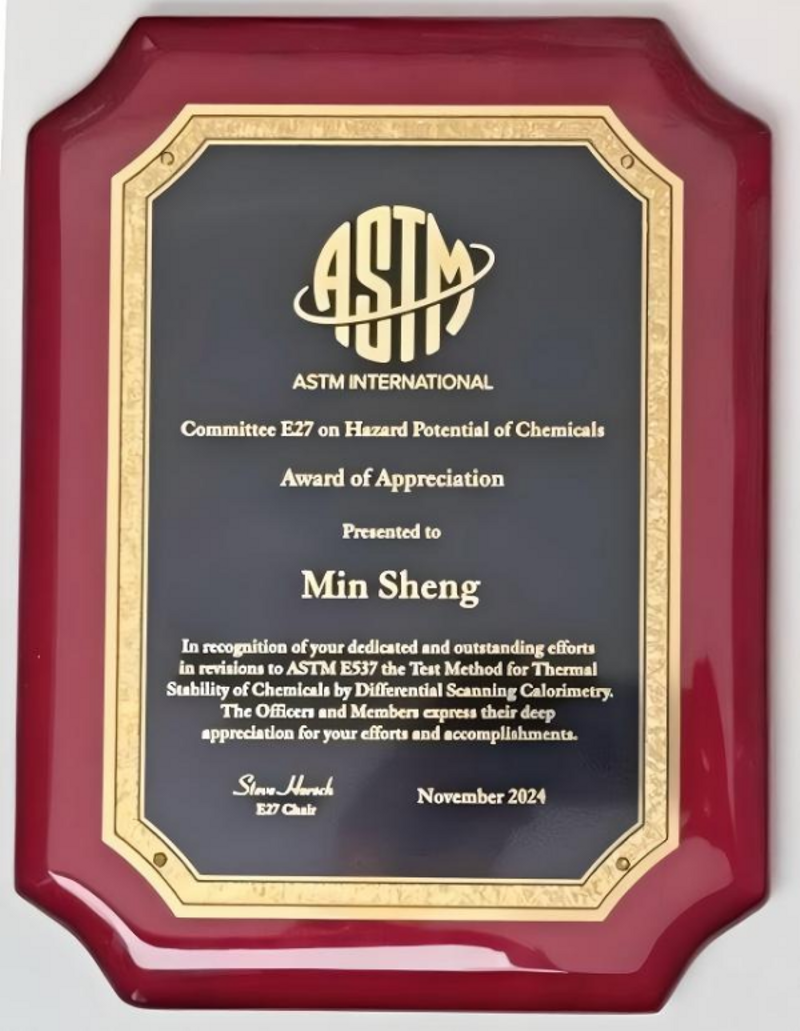
The ASTM E1981 standard focuses on the application of Accelerating Rate Calorimetry (ARC) in material thermal safety testing. It provides a scientific and standardized technical specification for evaluating the thermal stability of chemicals. Many countries, including China, have adopt or reference this standard for their own ARC testing protocols. The release of the 2026 edition further elevates the precision and reliability of these testing methods, offering a crucial framework for process safety evaluations involving hazardous chemicals in the global chemical industry.
A notable aspect of this revision is its direct connection to China’s domestic safety standards. The newly released ASTM E1981-26 fully incorporates key technical content from the Chinese group standard “Test Method for Thermal Stability of Chemicals-Accelerating Rate Calorimetry” (T/CCSAS 057—2025). This group standard, published by the China Chemical Safety Association (CCSAS) on July 28th, 2025, was also developed under Professor Sheng’s guidance and leadership. According to the CCSAS, this represents the first time that an international chemical safety standard has fully referenced a Chinese standard during its formulation.
The successful revision of this international standard highlights ECUST’s growing global influence in chemical thermal safety evaluation. It also represents a key outcome of the School of Resources and Environmental Engineering’s commitment to integrating scientific innovation with industrial development to serve national energy and environmental safety strategies. Moving forward, the research team will continue to focus on standard development and technological innovation in this critical sector.
?